Flower buying guide
Cut-Flower Care When Your Bouquet Arrives: The First Setup
Set up wrapped flowers in a clean vase, check a vase gift's water, and choose a practical display spot using extension guidance.
By Bloom Lane Flowers · Published
Options to compare
Formats to consider
These formats need different first setups: Gathered Garden includes a vase; the wrapped bouquet does not.
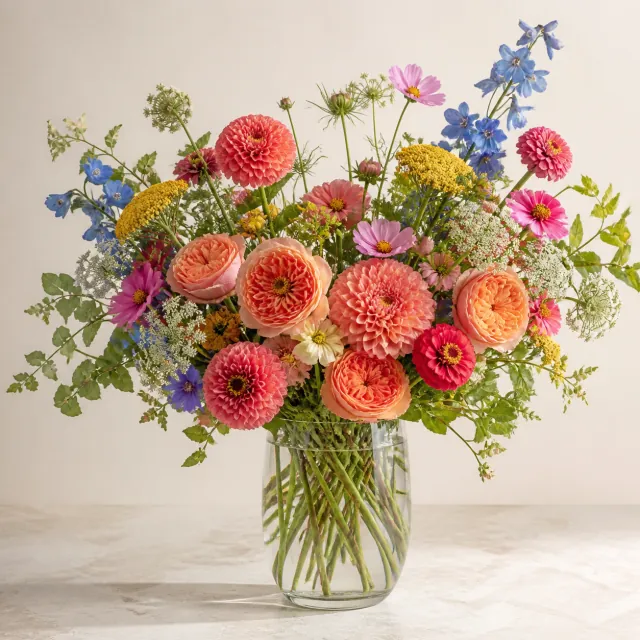
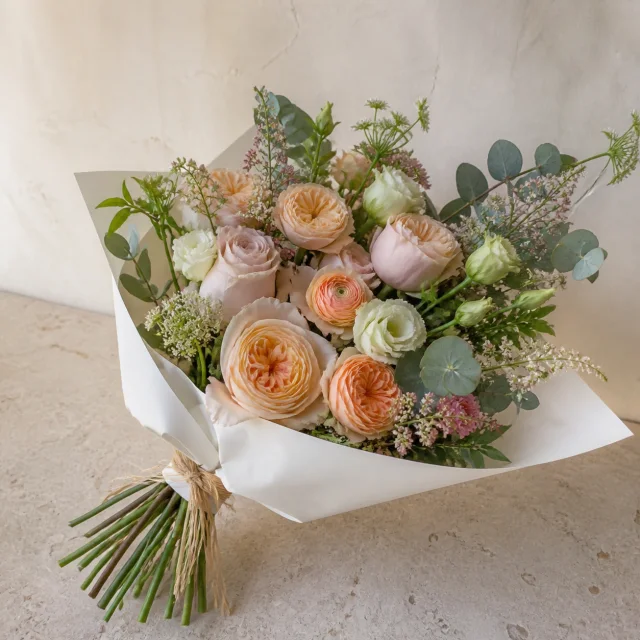
Check the selected product, delivery ZIP and available date before ordering. Availability and timing require confirmation; a requested arrival time or occasion deadline is not guaranteed by an available delivery day.
If your flowers arrive wrapped, get a clean vase and water ready before arranging them. If they arrive in a vase, start by checking the water and the accompanying instructions rather than taking the design apart. Both formats need water and a sensible display spot, but they do not require the same first setup.
The basic care below follows Iowa State University Extension’s How to Care for Cut Flowers and its related harvesting, conditioning, and care guide. It is general cut-flower guidance, not a promise about how long a particular bouquet will last. Keep any specific instructions supplied with your flowers, and ask the florist about unfamiliar containers or materials.
Wrapped bouquet: prepare the vase first
A wrapped gift is not necessarily a vase arrangement. For example, the catalog describes Seasonal Hand-Tied Bouquet as flowers wrapped for gifting, with no vase included. Plan the receiving setup accordingly.
1. Clear a work surface and choose a stable container. Use a sturdy vase that holds water and supports the stems without tipping. If you are using a vase from a cupboard, wash it with hot, soapy water and rinse it before use. Iowa State recommends cleaning previously used containers to remove debris and microorganisms. A vase that looks empty is not necessarily ready for new flowers.
2. Read the packet or care card before mixing water. If a commercial floral preservative is supplied, follow its directions, including the amount of water. Do not guess that a whole packet is right for every container. If you have no preservative, Iowa State’s related care guide recommends clean water without additives as the fallback. There is no need to experiment with sugar, pennies, mouthwash, or a homemade mixture.
3. Remove the gift wrapping carefully. Work where water will not damage furniture. Keep the care card and any preservative packet. A practical aim is to expose the stems for preparation without pulling on flower heads. If there is a binding you do not understand, ask before cutting through it; wrapping and structural support are not always the same thing.
4. Keep foliage above the water line. Remove leaves that would sit underwater in the chosen vase. Iowa State explains that submerged foliage can decay. You do not need to strip every leaf from every stem; focus on the portion below the water line.
5. Make a fresh stem cut and place the stems in water immediately. Iowa State recommends cutting roughly half an inch to an inch from the stem bottoms with a sharp knife. Use a tool you can handle safely and avoid crushing the ends. If using scissors, note that the extension guide says they are more likely to crush stems. Prepare your water first so the newly cut stems can go straight into it.
Arrange the flowers after that basic setup. Check that every stem reaches the water; a stem perched above it needs attention even if the bouquet looks balanced from the front.
Vase gift: check, do not automatically rebuild
Gathered Garden is described in the catalog as a mixed garden arrangement in a clear glass vase. That format already provides a container, so the first task is different from finding a vase for wrapped stems.
Place it on a stable surface, remove external transport packaging carefully, and check the water level. Make sure the stem ends have access to water. Add water when needed, following any supplied instructions. Do not add an extra packet of preservative blindly if you do not know what is already in the vase or how much water the packet requires.
You do not need to remove all the flowers simply to repeat the wrapped-bouquet steps. The related Iowa State guide notes that recutting is not necessary during a reasonably quick water change. If the arrangement uses concealed supports, floral foam, or a container whose water level you cannot assess, ask for format-specific care rather than assuming these open-vase instructions fit.
Choose the display spot before the photographs
Iowa State recommends a cool, brightly lit indoor location away from heat sources and drafts. Choose a stable place away from a heater or a drafty doorway rather than the most dramatic photo backdrop. This is a placement recommendation, not an exact room-temperature target or a guarantee of bloom longevity.
For a dining table, check that the vase can stay upright without being moved repeatedly around serving dishes. For a desk, give it a spot separate from electronics and papers that could be damaged by a spill. Those are practical placement choices, not horticultural performance claims.
Make tomorrow’s care easy
Check the water level daily and add water as necessary. Iowa State advises completely changing water if it becomes cloudy or starts to smell. When replacing water, follow the preservative directions again if you are using one. Keep the packet instructions accessible rather than throwing them away with the wrapping.
If flowers arrive with broken stems, a leaking vase, or another concern, contact the florist and describe what you see. Do not assume household care will correct every arrival problem. Your goal is a clean, hydrated, stable first setup—not a promised number of days on display.