Flower buying guide
Your Gift Orchid Has Arrived: Phalaenopsis Care in a Decorative Pot
Set up a delivered Phalaenopsis orchid with suitable light, check how its decorative pot drains, and water according to the growing medium rather than a weekly rule.
By Bloom Lane Flowers · Published
The Phalaenopsis gift discussed here
Keep the supplied care card and confirm this pot's growing medium and drainage before watering.
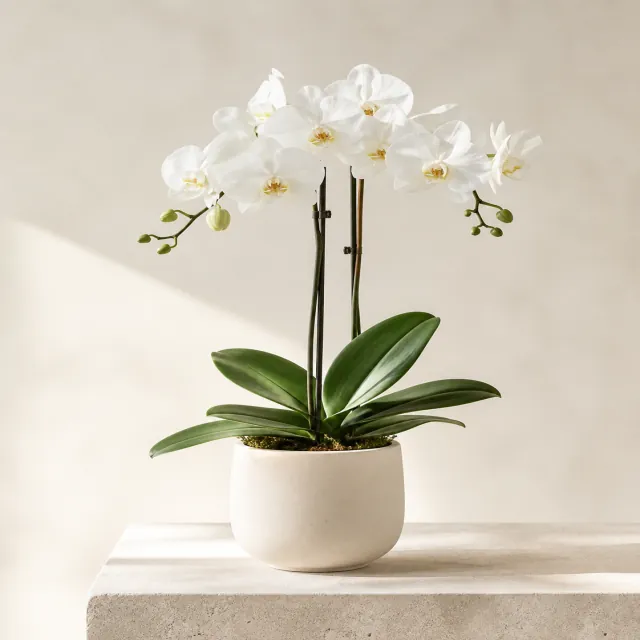
The orchid behind this guide: Signature Orchid is described as Phalaenopsis orchids in a ceramic vessel. Keep the care card with the gift and confirm its growing medium and drainage arrangement. Compare this group.
Check the selected product, delivery ZIP and available date before ordering. Availability and timing require confirmation; a requested arrival time or occasion deadline is not guaranteed by an available delivery day.
Jump to a section 5 sections
Give your Phalaenopsis orchid a bright spot with little or no direct sun, and check how its pot handles water before watering it. The aim is to moisten the growing medium thoroughly when it is nearly dry—not to keep it constantly wet or water automatically every week.
A decorative vessel is part of the display. It does not, by itself, tell you where the roots are growing or how excess water escapes. Keep the supplied care card nearby while you get to know the plant.
First, find the growing pot
Look at the container without pulling on the orchid’s leaves or flower stems. You are trying to answer three questions:
- Is there a separate growing pot inside the decorative vessel?
- Does the growing pot have drainage holes, and can it be lifted out safely?
- What is around the roots: bark, moss or another orchid growing medium?
If a separate pot lifts out easily, inspect its base and the inside of the outer vessel. If it is fixed in place, the roots are planted directly in the vessel, or you cannot see how water drains, ask the sender or florist for the matching watering instructions before adding water. Do not force the plant out to investigate.
A useful question is: “What medium is this orchid growing in, and how should I water and drain this exact container?” Mention any reservoir or wick described on the care card; that setup needs its own instructions.
Choose light for the leaves, not just a place for the flowers
The American Orchid Society’s Phalaenopsis culture sheet recommends a bright window with little or no sun. An east-facing window is a good starting point; a shaded south- or west-facing window can also work.
Choose a spot where the plant receives that light, rather than a dim interior shelf selected only because the flowers look attractive there. If strong sun reaches the leaves, use a shaded position or filter it with a sheer curtain. Protect the orchid from very cold window conditions, too; Clemson Extension cautions against placing orchids near a window during extremely cold weather.
Water when the medium is nearly dry
Both AOS and Clemson Extension advise watering Phalaenopsis thoroughly, then waiting until it is nearly dry before watering again. Do not let it become completely dry throughout.
Check the growing medium, not just the calendar. Ask the florist how to assess moisture in the medium supplied, especially if decorative material hides it. A dry-looking surface alone may not tell you what is happening deeper in the pot.
The interval changes with the medium, container, light and temperature. AOS also explains that higher humidity slows water loss, allowing the medium to retain water longer. A reminder to check the orchid can be useful; a reminder to add water regardless of its condition is not.
For a removable, freely draining growing pot
If your care card identifies a conventional draining pot rather than a reservoir system:
- Lift the growing pot out of the decorative vessel and take it to a sink.
- Water the growing medium thoroughly, allowing excess water to leave through the drainage holes.
- Let it finish draining before returning it to the display vessel. Empty any collected water so the pot is not left waterlogged.
- Keep water out of the crown—the central area where the leaves meet—and the leaf axils. Water in the morning so any wet leaves can dry.
Clemson warns against leaving orchids in a waterlogged pot. AOS likewise notes that Phalaenopsis roots can rot in soggy medium. For a fixed pot or a designed reservoir setup, get specific instructions instead of adapting these steps by guesswork.
Keep the routine simple
You do not need to repot the orchid just because it has arrived. If repotting becomes necessary, use guidance for Phalaenopsis and an appropriate porous orchid medium, not ordinary houseplant soil.
If the medium stays wet between checks, look at drainage and ask for advice rather than adding more water. If you are unsure what you are seeing, share photographs of the whole plant, growing medium and container with the florist. That is more useful than trying to diagnose a problem from a single fallen flower.
For the next living gift, Signature Orchid is Bloom Lane’s Phalaenopsis offering in a ceramic vessel. Ask for the pot-specific care instructions to travel with it. If you are still deciding whether a living gift is welcome, our birthday flowers-or-plant guide addresses that separate choice.
Further reading
Compare the flowers in this guide
The orchid behind this guide
Signature Orchid is described as Phalaenopsis orchids in a ceramic vessel. Keep the care card with the gift and confirm its growing medium and drainage arrangement.
Check the selected product, delivery ZIP and available date before ordering. Availability and timing require confirmation; a requested arrival time or occasion deadline is not guaranteed by an available delivery day.
If the recipient wants an orchid to care for, review the product options and ask for instructions matching the supplied pot and growing medium.