Flower buying guide
Choosing Flowers From a Product Photo: What Else You Need to Know
Read the product image alongside the description and selected size and palette, and clarify measurements or ingredients that matter to your order.
By Bloom Lane Flowers · Published
Options to compare
Formats to consider
Read the description and selected size and palette alongside the photo. Confirm essential dimensions, ingredients and container details separately.
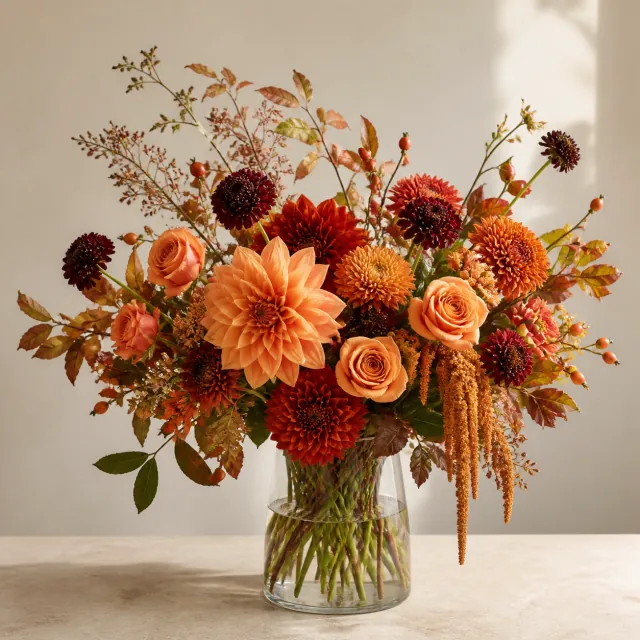
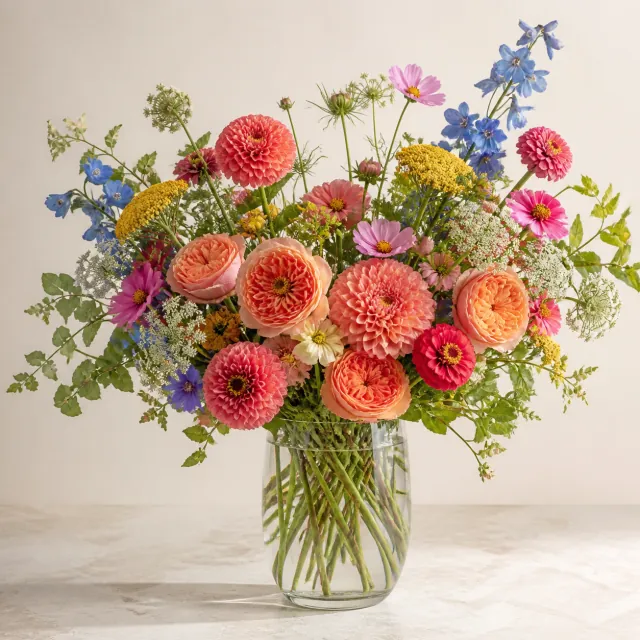
Check the selected product, delivery ZIP and available date before ordering. Availability and timing require confirmation; a requested arrival time or occasion deadline is not guaranteed by an available delivery day.
Use a flower product photo to decide whether you like the visual direction, then read the description and check the options you have selected. If an exact flower, container detail, or finished measurement is essential, clarify it before ordering. An attractive image is not enough evidence to resolve every part of the purchase.
The useful question is not simply “Will it look like the picture?” It is “Which parts of this picture matter to me, and where does the product actually describe them?” That turns a vague expectation into a question someone can answer.
Read the image in four layers
Visual impression. Notice whether you prefer a loose garden effect, a denser silhouette, soft colors, or stronger contrasts. A photo is useful vocabulary for that preference. You can say, “I like the movement and the lighter palette,” without claiming to know every stem in the arrangement.
Written description. Look for the stated format and design approach. Does the copy say it is arranged in a vase, wrapped, or designer-selected? Those words help distinguish the product from a style you have inferred from the image.
Selected options. Check the actual size and palette selected for your order. A product can have several choices; do not assume the main photo establishes which one you have picked. A size name or palette label should be read as its own information, not as an exact measurement or recipe.
Unresolved requirements. Anything essential that those sources do not answer belongs in a question before purchase. Examples include a maximum display width, a required ingredient exclusion, or a particular container feature. A note requesting a feature is not confirmation that it can be supplied.
Two catalog examples show why the words matter
Designer’s Choice is described as designer-selected flowers in the scale and direction you choose. Its catalog size options are Petite, Signature, and Statement. Petite is described as a compact gesture for a desk or side table; Statement is described as greater scale with premium stems. Those are qualitative descriptions, not finished heights or widths.
Its palette labels include Seasonal mix, Bright & joyful, White & green, Blue & lavender, Yellow & cream, Red & wine, Pink & blush, and Soft pastel. The catalog marks its palette mode as a preference. A preferred direction does not identify the precise flowers or their proportions. If the exact blue flower in an image is your reason for ordering, ask about that flower rather than assuming the palette name guarantees it.
Gathered Garden is explicitly described as a mixed garden arrangement in a clear glass vase. Its size options are Classic, Signature, and Full. The Classic description refers to a desk or side table; Full refers to greater flower coverage and a fuller garden silhouette. Again, these do not state measured finished dimensions.
Gathered Garden’s palette labels include Seasonal garden, Cream, white & ivory, Soft pastel, Blue & lavender, Yellow & cream, Pink & blush, and Red & wine. The Soft pastel description names blush, lavender, cream, and pale seasonal color. That is useful palette information, but it is not an itemized recipe. It also shows why you should read the particular product’s wording instead of borrowing expectations from another product with a similar photo.
Turn a visual preference into a precise question
Suppose you love a photo because it looks comfortably sized for a narrow shelf. Your actual requirement is shelf fit, not photographic resemblance. Measure the usable shelf space and ask:
“The display area allows this much width and height. Can the selected size work within those limits? I need clarification before choosing the option.”
Do not estimate inches by comparing the arrangement with a vase, table edge, or other object in the photo. The picture does not give you the measurements of those reference objects.
Or suppose you choose flowers to complement a room with a soft palette:
“I prefer blush, cream, and pale lavender. Is the Soft pastel option the appropriate direction, and what aspects of the flowers remain designer-selected?”
If a single named flower is nonnegotiable, ask that separately. Do not bury the requirement inside “please make it exactly like this.”
Review the order, not just the image
Before committing, check that the product name, selected size, and selected palette reflect what you intend. Keep any separately confirmed requirement clear and distinguish it from a preference. If an answer remains unresolved, decide whether the uncertainty is acceptable or whether you need a different product.
A photo can make choosing flowers enjoyable. The description, option labels, and clarifying answers make the choice informed. You do not need certainty about every stem; you do need clarity about the details that would make the gift unsuitable if they were different.