Flower buying guide
What Does Designer's Choice Mean When You Order Flowers?
Understand florist discretion, palette preferences and the limits of exact flower requests in a Designer's Choice arrangement.
By Bloom Lane Flowers · Published
Options to compare
Formats to consider
Palette direction is a preference, not an exact flower recipe. Resolve any indispensable ingredient or dimension before ordering.
Check the selected product, delivery ZIP and available date before ordering. Availability and timing require confirmation; a requested arrival time or occasion deadline is not guaranteed by an available delivery day.
Designer’s Choice means you choose the broad direction and let the florist choose the flowers used to build the arrangement. It suits someone who wants a considered design without requiring a particular stem-by-stem recipe. It is less suitable when the gift only works if one exact flower or combination appears.
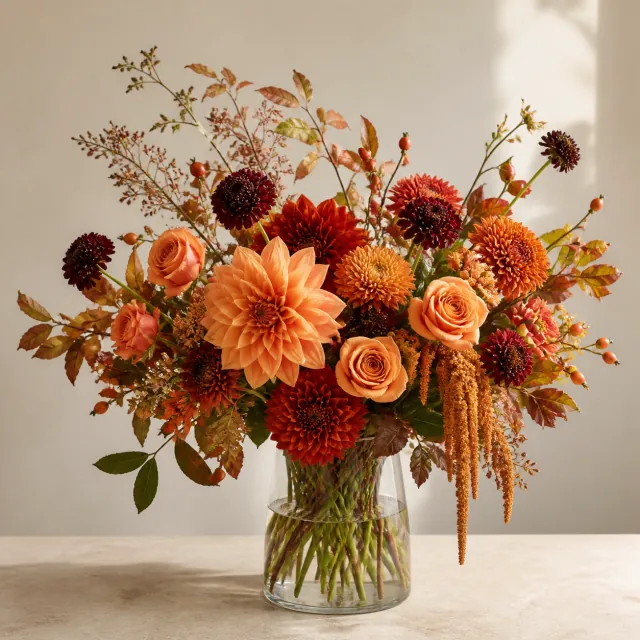
Bloom Lane’s Designer’s Choice is described as a florist-selected arrangement in the scale and direction you choose. The catalog identifies palette selection as a preference. Read that as direction for a florist-led arrangement—not a promise to reproduce every flower visible in a photograph.
What you decide
You still make meaningful choices. In this catalog, Designer’s Choice has Petite, Signature and Statement size options, along with palette directions such as White & green, Blue & lavender, Yellow & cream and Pink & blush. A Seasonal mix option leaves the color direction more open.
That gives you a way to match a known preference without naming every bloom. Someone who likes lighter colors may appreciate a softer direction; someone who enjoys varied seasonal flowers may prefer to leave more decisions to the florist.
Scale is a separate decision. Petite is described as a compact gesture for a desk or side table, while Statement emphasizes greater scale. These descriptions help explain the options, but they do not provide exact dimensions or stem counts. Choose the tier for the intended gesture and seek measurements separately if physical fit is essential.
What you leave to the florist
The flower selection is the part you are entrusting to the designer. A palette description does not establish an exact recipe, and a product image does not list a guaranteed ingredient set.
For example, “Yellow & cream” tells the florist the direction you prefer. It does not, on its own, tell you that a particular yellow flower will be used. “Seasonal mix” is broader still. The catalog’s Designer’s Choice imagery and seasonal color presentation change with its seasonal profile, which is another reason not to treat a single pictured arrangement as a fixed inventory list.
This flexibility is useful if your priority is the overall result rather than one indispensable flower. It is not a workaround for a requirement that remains unconfirmed.
Preference and requirement are different things
Before ordering, put your wishes into two categories.
A preference leaves room for interpretation. You might say that the recipient likes pink and blush tones, or that you want a softer rather than a vivid palette. The catalog’s palette choices give you a defined place to start.
A requirement decides whether the order is suitable at all. If the gift must include a particular flower, exclude a particular ingredient or fit a tightly constrained space, that point needs an explicit answer before you rely on it.
Do not assume an order note changes a preference into a guarantee. Nor should you assume Designer’s Choice includes a custom substitution service simply because the florist chooses the stems. Asking whether a requirement can be met is different from knowing it has been accepted.
A useful question is: “I am considering Designer’s Choice, but this particular requirement is essential. Can you confirm whether that product is appropriate before I order?” If you cannot get a clear answer, do not choose the flexible product while hoping the requirement will be understood later.
Three ways to recognize a good fit
You know the recipient’s favorite palette, not their favorite flowers. Designer’s Choice may let you use that genuine preference while leaving the detailed selection to the florist. There is no need to invent a flower list to make the gift personal.
You like seasonal variety. The appeal is allowing the selection to reflect what the florist is working with, rather than expecting one photograph to define every order. Choose this when variation is acceptable to you.
You want to recreate a specific remembered bouquet. This is a reason to stop and ask, not to assume. If matching those flowers is the whole point, the flexible format may not be the right purchase without further confirmation.
These examples turn on your tolerance for variation. Designer’s Choice is not automatically a better option for every recipient, and choosing a more specific product does not automatically guarantee every pictured detail either. Always read the actual description.
Make the decision explicit
Finish this sentence before you order: “The gift succeeds if the arrangement has ___, and I am comfortable leaving ___ to the florist.”
If the first blank is a broad palette and scale, and the second is the individual flowers, Designer’s Choice fits the decision well. If the first blank contains an exact bloom or recipe, resolve that point first.
You are not giving up thoughtfulness by trusting the florist. You are deciding which choices matter to the recipient and which can remain creative. The best fit is one where that distinction is clear before the flowers are ordered.