Flower buying guide
Event Centerpiece Flowers: What to Confirm Before You Order
Prepare a usable table brief covering sightlines, quantities, venue approval, and the people responsible for setup and removal.
By Bloom Lane Flowers · Published
Options to compare
Formats to consider
Use these as style references for an agreed table brief, not as promises of exact dimensions, matching recipes, custom event services or installation.
Check the selected product, delivery ZIP and available date before ordering. Availability and timing require confirmation; a requested arrival time or occasion deadline is not guaranteed by an available delivery day.
Before ordering event centerpieces, confirm the table layout, the space the flowers may occupy, the number of arrangements, and who will place and remove them. A product photograph can help you describe a style; it cannot tell you whether guests will see across your actual table or whether the venue permits that display.
Treat the order as the result of a table brief, not as the starting point. A brief makes your nonnegotiable requirements visible before anyone chooses a flower palette or a size label.
Build the table plan before the flower plan
Begin with a current layout from the organizer or venue. Record which tables need flowers and which do not. Dining tables, a registration table, a speaker table, and a buffet are different jobs; they should not automatically receive the same arrangement.
For each table type, note:
- Its shape and measured dimensions.
- The number and position of seated guests, if applicable.
- Space already assigned to food, glassware, place settings, signs, microphones, or other decor.
- The surface area left for a floral display.
- Whether people must talk, see a speaker, or read a sign across it.
Measurements of your available space are useful requirements. They are not evidence that a catalog arrangement will fit. Ask for clarification of the proposed arrangement’s expected footprint and height before treating a size tier as suitable.
For a seated meal, describe the sightline you want preserved: “Guests opposite one another need a clear view when seated.” That is more useful than “small centerpiece,” which means different things to different people. If you already have a sample table set up, use it to understand your own space constraints; do not infer finished flower dimensions from a photo taken elsewhere.
Count placements, not just tables
Assign each desired placement a label. A simple planning example might be six dining-table displays, one welcome-table display, and no flowers on the buffet. That produces seven requested placements—not eight because someone added the buffet to a generic table count.
For a long table, decide whether you want one focal arrangement or several separate displays. The choice affects usable space and quantity, but neither choice determines a florist’s recipe. Share the intended layout and ask what can be accommodated rather than assuming any standard product can be divided, repeated identically, or resized.
Resolve uncertain guest numbers before confirming the final quantity when possible. If the layout is not settled, mark the count as provisional and ask how changes would be handled. Do not presume extra arrangements or late changes are available.
Separate style references from service requests
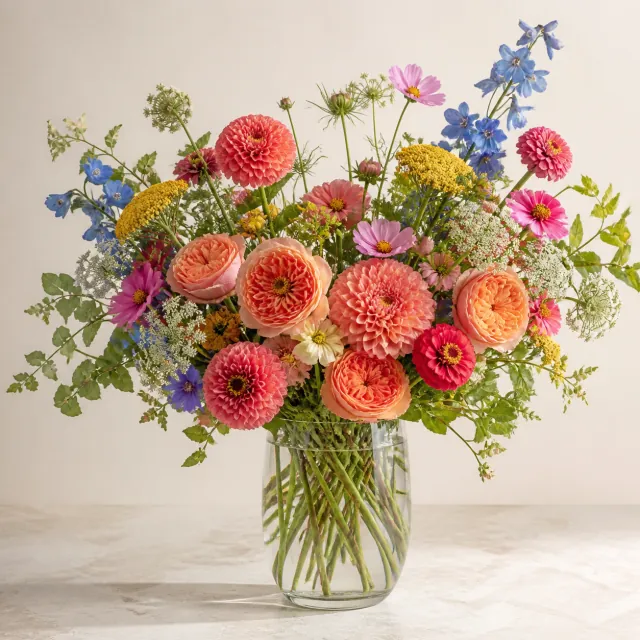
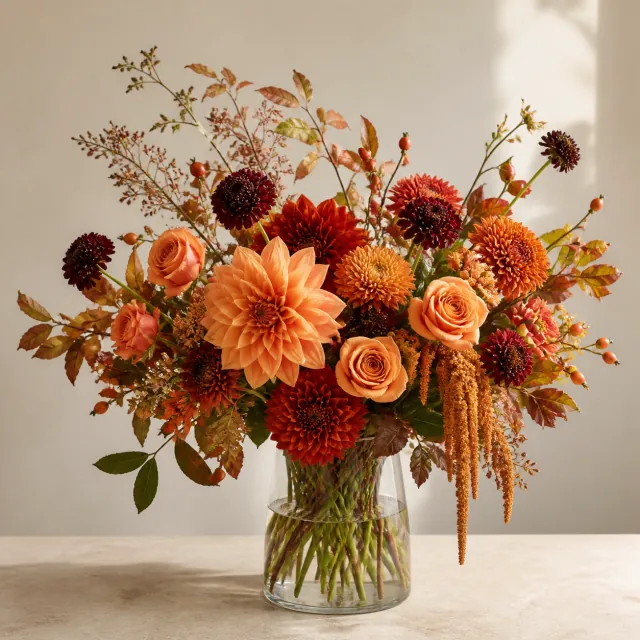
Gathered Garden, described as a mixed garden arrangement in a clear glass vase, can be a starting point for discussing a garden-style vase display. Designer’s Choice describes designer-selected flowers in a chosen scale and direction. Neither product description establishes a custom event package, installation service, or guarantee that several arrangements will match bloom for bloom.
Say which aspects of a reference matter: a clear glass vase, a loose garden impression, or a preferred palette. Keep those separate from hard constraints such as table footprint and sightlines. If exact matching flowers, containers, or measurements are essential, obtain a specific confirmation before ordering; a request alone is not acceptance.
A copyable organizer’s brief
Event: Private dinner, with seated conversation as the priority.
Placements: Six dining tables and one welcome table; layout pending final venue approval.
Table information: Measured dimensions and a place-setting plan attached.
Flower space: Marked on the plan; arrangements must not displace service items.
Visual direction: Garden-style flowers in glass vases, with a preferred soft palette.
Questions: Which proposed format and scale can meet these constraints? What remains variable?
Responsibilities: Organizer to confirm receiving, placement, ongoing care, and end-of-event removal. No installation service assumed.
Replace the example with your actual information. Do not attach private guest details when a table plan will answer the question.
Give every handoff a person
Ask the venue’s authorized contact about flowers, containers, placement, and any surface protection requirements. Confirm when the organizer can access the room. Venue permission and fulfillment arrangements are separate confirmations; one does not prove the other.
Then name the person receiving the flowers, the person setting them on the approved tables, and the person removing them afterward. If you want florist setup or another additional service, ask explicitly and wait for confirmation of scope. Ordering vase arrangements is not the same as booking installation.
The final ordering decision should rest on an agreed layout, confirmed quantity, clarified product expectations, and assigned responsibilities. If one is missing, finish that part of the brief first. Flowers should support the event you have planned—not require the room to be rearranged around an assumption.