Flower buying guide
Flowers for a Workplace Reception: Who Owns the Arrangement?
Plan flowers for a shared reception area by assigning permission, placement, care, and removal to specific people.
By Bloom Lane Flowers · Published
Options to compare
Formats to consider
Choose only for an approved display location with a named owner and willing backup for care and removal.
Check the selected product, delivery ZIP and available date before ordering. Availability and timing require confirmation; a requested arrival time or occasion deadline is not guaranteed by an available delivery day.
For flowers in a workplace reception area, name an owner before choosing an arrangement. Here, ownership means responsibility for the display: getting permission, agreeing on its location, following care instructions, and removing it when it no longer belongs there. It does not mean the flowers are a gift to the receptionist.
A shared-space arrangement can have many admirers and still have nobody responsible for it. The simplest solution is a short agreement between the organizer and the person authorized to manage that space. Reception staff should not discover they have inherited another task when the flowers arrive.
First distinguish decor from a personal gift
This decision is about flowers intended to remain in a common reception area. If the arrangement belongs to an employee, its placement and eventual destination should follow that person’s wishes instead. Do not convert a private gift into workplace decor just because the front desk received it.
For a shared display, identify the purpose and duration: welcoming visitors during a particular gathering, adding flowers for a planned reception, or a one-off display in an approved location. Avoid leaving the end date as “until someone deals with it.” An organizer can set a review point without promising that the flowers will look their best for any fixed number of days.
A useful internal note is:
“This arrangement is for the shared reception area, not for an individual employee. Morgan is responsible for placement and care, with Casey as backup. Morgan will review the display and arrange removal.”
Use actual names only in the private coordination note; the public display does not need staff contact information.
Choose the location before the scale
Ask the space manager where flowers may go. Discuss the work that already happens there: signing in, handing over paperwork, viewing a screen, reaching a phone, or reading a sign. The preferred display spot should leave that work usable. Do not assume the middle of a reception counter is spare space.
Measure the available surface and describe the maximum area you can allocate. If an arrangement’s height or width matters, ask for clarification before selecting a size. Catalog names such as Classic or Full do not establish finished dimensions.
Consider the container too. Is the proposed surface suitable for a vase, and does the space manager require protection beneath it? Ask rather than treating either workplace furniture or a flower container as automatically suitable. Keep the display in an approved place instead of moving it among counters to find somewhere it fits.
Use the product description to choose a starting format
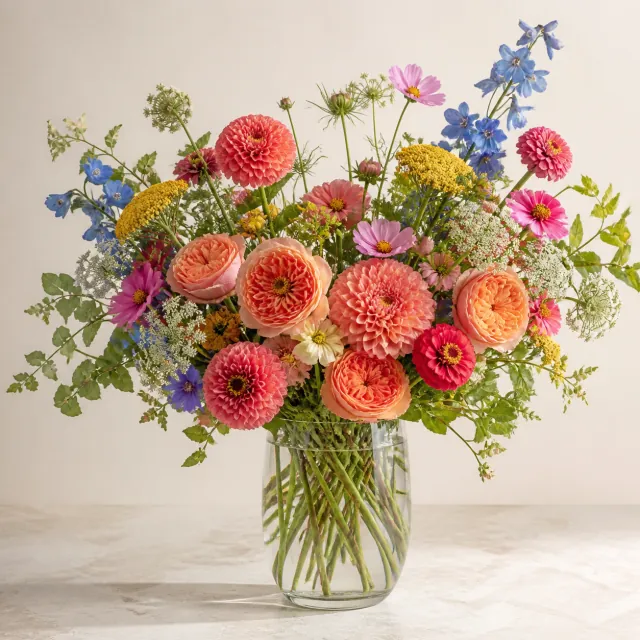
Gathered Garden is described as a mixed garden arrangement in a clear glass vase. Its catalog lists Classic, Signature, and Full size options. Those are choices to discuss in relation to your space, not guarantees about its footprint.
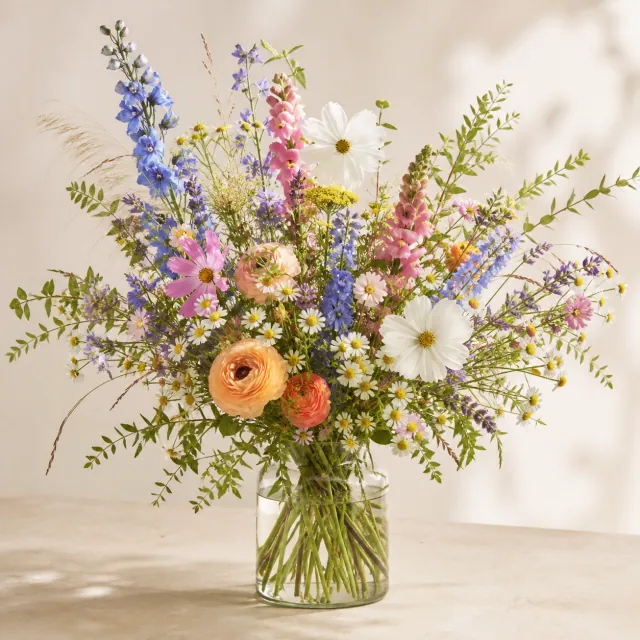
The Wildflower Arrangement is described as an airy meadow-style mix with loose seasonal movement, and its catalog image description identifies a clear glass vase. If that visual direction appeals to you, ask whether the proposed scale and container work for the approved location. “Airy” describes a style; it does not establish that the arrangement will leave a clear view across the desk.
If the workplace has restrictions on flowers or known preferences about fragrance, ingredients, or decor, raise them before buying. Neither product name establishes suitability for everyone who uses a shared room. A required ingredient restriction needs specific confirmation, not a reassuring guess based on the picture.
Assign care without assigning blame
The owner should obtain and follow the instructions supplied with the arrangement. Agree on access to whatever is needed to carry out those instructions and on who will act when the primary owner is absent. Do not make the task dependent on an unnamed person noticing that something needs attention.
Keep the care plan modest and specific:
- Primary owner and willing backup.
- Approved display location.
- Location of supplied care instructions.
- A point for reviewing the display’s condition and continued suitability.
- A plan for the vase and flowers after removal.
This is a responsibility list, not a universal care schedule. The appropriate handling depends on the actual arrangement and its instructions.
Decide what happens at the end
Flowers intended for reception do not automatically become the property of whoever closes the office. If someone wants to take them home, arrange that with the organizer and the space manager. If the workplace owns the container, say where it should go. If no one wants the flowers afterward, the owner should follow the workplace’s applicable disposal process rather than leaving the task for cleaning staff without agreement.
Before ordering, be able to finish this sentence: “The arrangement goes here, with this person’s permission, and this named person will look after it and remove it.” If you cannot, the missing item is an ownership decision—not a flower choice.