Sympathy buying guide
Sympathy Flowers for a Friend at Home: A Considerate, Manageable Gift
Choose a welcome home condolence gift and write a personal message that leaves your friend free not to answer.
By Bloom Lane Flowers · Published
Options to compare
Welcomed home gifts to consider
For a welcomed home condolence gift only. Confirm manageable size and household suitability; Serene Bouquet lists lilies and is not palette-customizable.
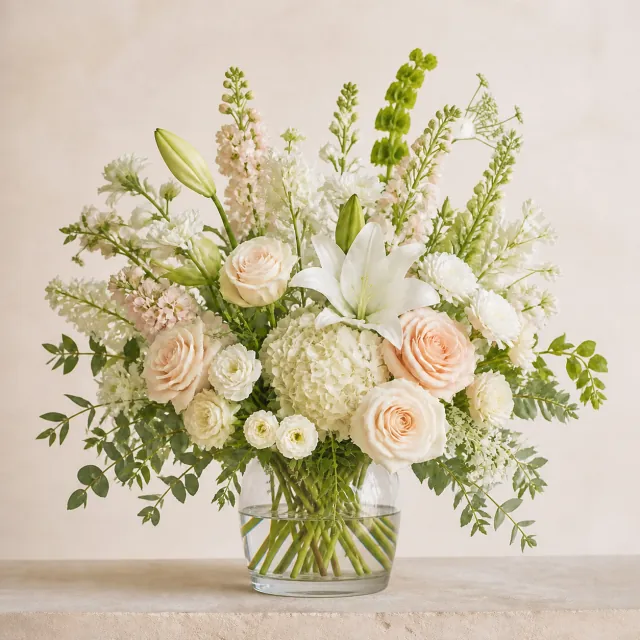
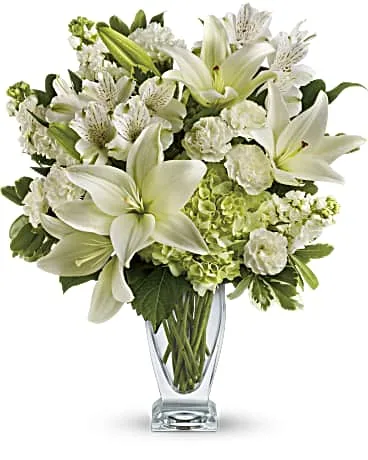
Check the selected product, delivery ZIP and available date before ordering. Availability and timing require confirmation; arrival before a service is not guaranteed by an available delivery day.
For a friend grieving at home, choose flowers only if they are welcome, keep the arrangement manageable, and write something personal that does not require a response. You are supporting your friend, not recreating a funeral display or trying to find words that will resolve the loss.
Follow any family request for donations or no flowers. If your friend does not want a delivery, a private message or an agreed practical favor can stand on its own. Friendship does not make a surprise gift automatically appropriate.
Speak as their friend, not as an expert on grief
Start with what is true between you. You can acknowledge the loss, say that you care, and offer one genuine memory if you have it. You do not need to explain what your friend must be feeling or offer a prediction about when things will become easier.
Avoid asking them to reassure you about the message. “I don’t know what to say; please tell me I haven’t upset you” gives your friend another person’s feelings to manage. A simpler sentence—“I am so sorry, and I love you”—can be enough.
Similarly, leave explanations such as “everything happens for a reason” out of the card. You cannot assume your friend shares that belief or wants to hear it now. Describe your own care rather than assigning meaning to their loss.
Three personal messages, for different friendships
These are starting points to adapt, not scripts that require a particular response.
You knew the person who died.
“Leah, I am so sorry about your dad. I still remember how he made room for all of us at his kitchen table. Sending you love. You don’t need to reply. Sam.”
Use a memory that belongs comfortably on an enclosure card. Do not include sensitive family history or details your friend might not want another household member to read.
You did not know the person, but you know your friend well.
“Leah, I’m thinking of you and your family. I won’t pretend to have the right words, but I am here and I care about you. With love, Sam.”
You can be close to your friend without claiming a relationship with the person who died. There is no need to invent a memory or praise you cannot personally support.
You are reconnecting after time apart.
“Leah, I was very sorry to hear about your loss. I remember our friendship with warmth and wanted you to know I’m thinking of you. No reply expected. Sam Patel.”
A recognizable signature helps. Do not turn the condolence into a request to restart the friendship, explain the distance, or arrange a reunion.
Choose flowers your friend can comfortably have at home
Gentle Embrace is described in Bloom Lane’s catalog as a family-home arrangement in white and green or soft pastel. It is a useful format to consider when your friend welcomes flowers and a supplied vase suits their space.
Serene Bouquet is described as white flowers with greenery in a clear glass vase. The catalog lists lilies among its flowers and does not offer palette customization. Do not choose it on the assumption that its ingredients can simply be removed or replaced. If the household has flower restrictions, fragrance concerns, or pets, resolve suitability with the recipient and seller before selecting it; a different gift or a note may be preferable.
For either option, check the actual size and container rather than choosing the largest tier as a measure of friendship. Think about a table your friend could use without rearranging the room. A vase arrangement still needs care, and no product name establishes that it will suit every household.
Keep these as home gifts. A floor display, easel tribute, or casket arrangement is not the default for a friend’s living room.
Separate the gift from an offer of help
The flower card is not a good place to ask your friend to coordinate an errand. Make any practical offer privately and keep it small enough to decline easily:
“If it would help, I could collect your grocery order on Thursday. If not, that’s completely fine.”
Only offer something you can actually do. Avoid arriving with flowers, food, or company without agreement. Saying “no reply needed” while asking three questions about a visit sends mixed instructions.
You can also check in later without asking whether the flowers were displayed or photographed. The gift does not purchase an update, a thank-you message, or access to the family’s plans.
Use what your friend has agreed to share
Confirm a welcome receiving date and the correct address privately. Do not use a home address found online or assume an old address is current. If someone else is coordinating deliveries with the family’s permission, use that person rather than sending your friend repeated logistical questions.
If you cannot establish a comfortable receiving plan, send the message now and leave the purchase for another time. Your friend can receive care without receiving an object. A personal sentence, a manageable welcome gift, and patience about the next conversation are enough.