Flower buying guide
Flowers for a Team Celebration: One Shared Gift or Individual Gifts?
Choose a shared arrangement or individual bouquets by deciding who is included, who owns the flowers, and what each person welcomes.
By Bloom Lane Flowers · Published
Options to compare
Formats to consider
Decide who is included and who owns the flowers afterward. Individual wrapped gifts need separately agreed receiving and vase plans.
Check the selected product, delivery ZIP and available date before ordering. Availability and timing require confirmation; a requested arrival time or occasion deadline is not guaranteed by an available delivery day.
Choose one arrangement when the flowers are meant to belong to the celebration, not to a particular person. Choose individual gifts when you want each team member to receive something of their own—and each person actually welcomes flowers. Neither approach is automatically fairer. The fair choice depends on who can enjoy the gesture, how you recognize the whole team, and who gets the flowers afterward.
Start with those decisions before comparing arrangements. A beautiful shared display can exclude people who are not in the room; a row of individual bouquets can create an obligation for people who do not want to carry or care for them.
What is the gift supposed to do?
A useful distinction is marking a shared moment versus giving each person a personal thank-you.
For a project lunch, one arrangement on a common table can mark the group’s achievement without turning flowers into a prize. For a small team finishing a demanding assignment, individually welcomed bouquets may make the recognition feel personal. If some colleagues work elsewhere, ask whether flowers are the right common gesture at all. You do not need to solve every difference by buying more flowers.
Write one sentence that defines the intention:
“These flowers are for our team lunch, with a message recognizing everyone who contributed—including colleagues joining remotely.”
Or:
“We would like to offer each team member a bouquet, with an easy way to decline or choose a different form of thanks.”
That sentence prevents a shared celebration from quietly becoming a gift for whoever happens to sit nearest the vase.
Make a shared arrangement genuinely shared
A shared gift needs an owner for practical purposes, even when it belongs symbolically to everyone. Name someone to choose an approved display spot, look after the arrangement, and handle it when the celebration ends. Do not assume the person who ordered it will be there afterward.
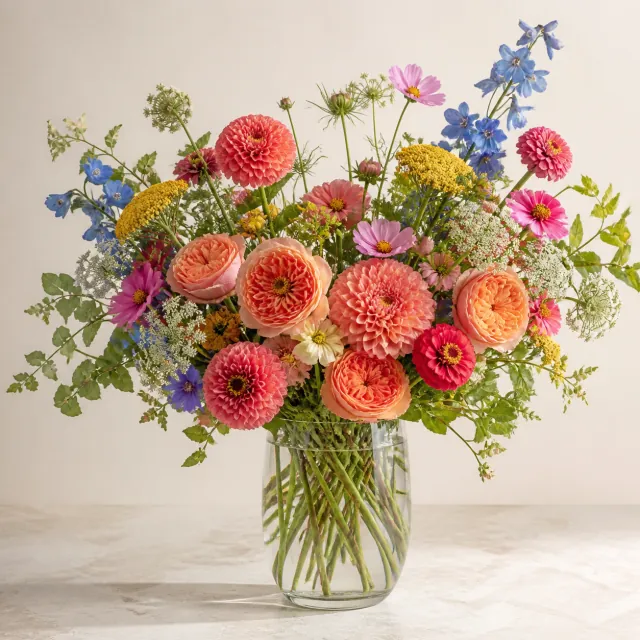
Gathered Garden is described in the catalog as a mixed garden arrangement in a clear glass vase. That format is worth considering for a shared display because the group is not being handed a wrapped bouquet that needs a separate vase. It still needs an agreed location and someone responsible for it. The catalog’s size labels are not measurements of your table.
Set the final ownership rule before the event. Possible approaches include keeping the flowers in a shared space with permission, offering them to a volunteer, or agreeing on a recipient in advance. Avoid promising the vase to several people or letting seniority decide by default. If nobody wants the after-event responsibility, reconsider the gift.
The card should identify the group rather than a single visible contributor:
“For the entire launch team: thank you for the planning, testing, coordination, and behind-the-scenes work that brought this project together.”
Use the team’s own description of its work. Do not invent contributions or leave less visible participants out of the thanks.
Individual gifts: consistent recognition, flexible receiving
For individual gifts, agree on a comparable gesture without insisting that everyone receive exactly the same thing. A colleague who declines flowers should not have to justify a private preference in front of the team. Ask privately and make declining straightforward.
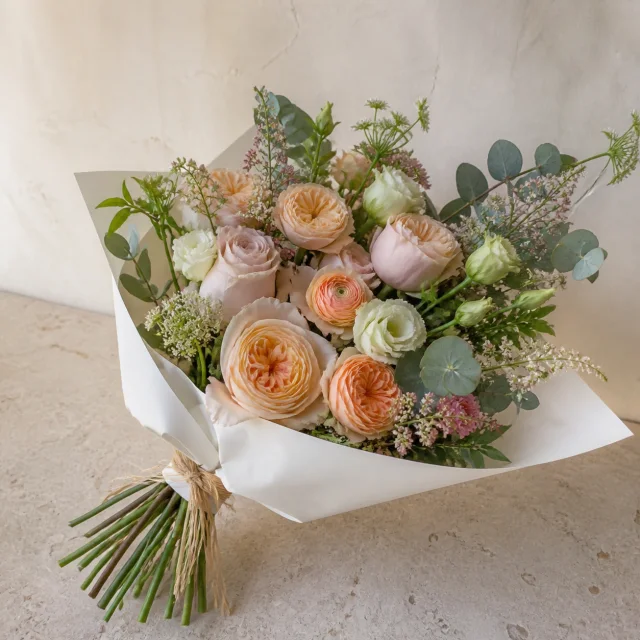
The Seasonal Hand-Tied Bouquet is a wrapped flower gift; the catalog explicitly says a vase is not included. That matters if you plan to hand bouquets out at the end of a workday. Confirm that recipients want to carry them and have a way to put them in water. A vase arrangement may suit some people better, but a different format should not become a public ranking of their contribution.
Work out each receiving plan individually. Some people may prefer a handover at the gathering; others may decline or suggest another agreed destination. Do not circulate home addresses on a team spreadsheet. Do not assume one order can cover several addresses or that a larger quantity comes with a discount. Confirm ordering arrangements separately before committing to a plan.
A decision example
Imagine a six-person team, with four people attending lunch and two joining online. One vase arrangement at lunch is reasonable if it is clearly event decor and the recognition includes all six. It is less convincing if you call it “everyone’s gift” and then give it to the manager without discussing that choice.
If the intention is six personal gifts, first ask whether each person wants flowers. Then agree on the recognition standard and the receiving details. The point is not six matching photographs; it is six people being considered.
Before buying, answer three questions: Who is included? Who owns the flowers afterward? Does the chosen format ask anyone to do something they have not agreed to? Those answers make the celebration more thoughtful than simply choosing the largest arrangement.