What color flowers are appropriate for a Hindu funeral?
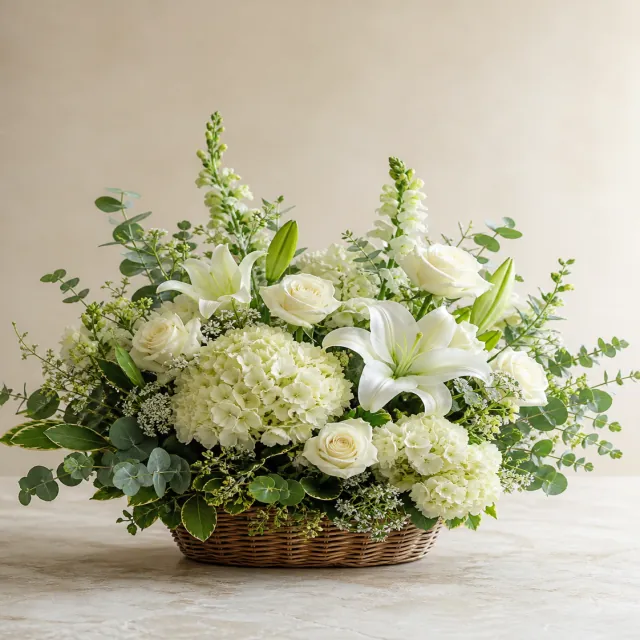
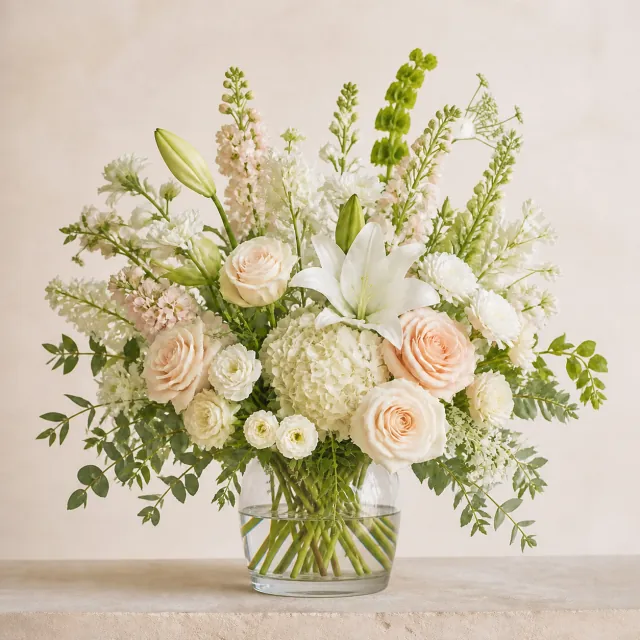
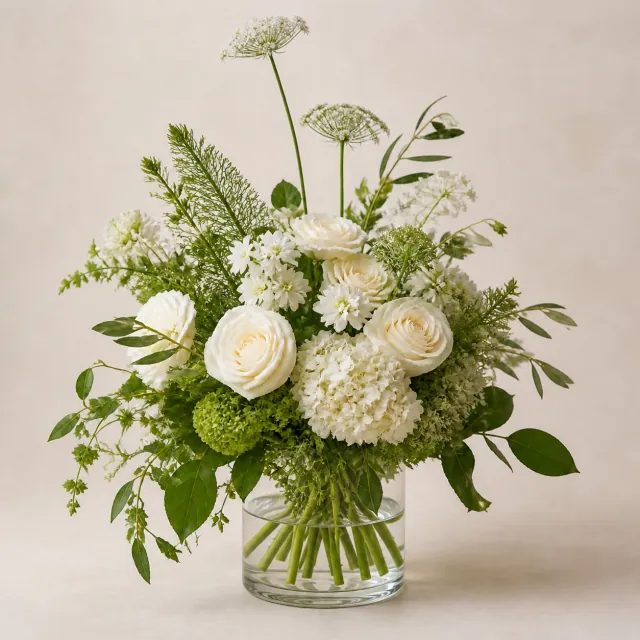
White is closely associated with mourning in many Hindu communities. The Hindu Temple of Delaware notes that in North India everyone wears white to a funeral, and Hinduism Today describes mourners in Nepal wrapping themselves in unsewn white cloth. For a guest arrangement, white, cream, and green is the choice least likely to clash with the family’s rites.
White is not a universal rule, though. The same temple page says that in South India not everyone wears white. Ritual flowers can be bright: Hinduism Today describes marigold-covered bodies at cremations beside Kathmandu’s Pashupatinath temple. The Sahara funeral resource book, published by Delaware’s Indo American Association and Hindu Temple Association, says a married woman who dies before her husband should be dressed in red. These choices belong to the family and priest, so do not choose red or bright colors for a guest arrangement without asking.
Hindu families in and around New York come from many traditions, including North and South Indian, Gujarati, Bengali, Tamil, Indo-Caribbean, and Nepali communities. Hinduism Today notes that mourning practices follow a similar pattern across the Hindu world but differ in detail by family relationship, community, region, and other factors.
How are flowers used in Hindu funeral rites?
At a Hindu funeral, flowers are woven into the rites. The Hindu American Foundation (HAF) describes a brief service at which the body, with a garland of flowers around its neck, lies in a simple casket while friends and family recite hymns, prayers, and mantras. HAF’s overview of Hindu funerals describes a final viewing, or darshan, with an oil lamp burning at the head, where a pandit or elder chants mantras as mourners offer garlands or flower petals.
Tulsi, or holy basil, has a place too. HAF describes tulasi leaves placed on the lips with drops of Ganges water, and the Delaware resource book lists a flower garland, loose flowers, and tulsi leaves among the items for last rites, a list written with advice from a temple priest.
Flowers continue at home. The Delaware resource book says a photograph of the deceased may be displayed with a garland during the mourning period, and Hinduism Today describes a garlanded photo outside each family’s room at a hall for mourners in Kathmandu.
Should you bring a garland or send flowers?
Bring a garland only if the family asks. The garlands, petals, and tulsi used in the rites are usually arranged by the family with the priest. The Hindu Temple of Delaware tells grieving families they need not worry about the items for last rites, because its priest can bring them.
Guest flowers are handled differently from family to family. The Association of Mandhata Samaj UK (AMSUK), in its guide for Koli Patel families in Britain, sets aside space at the home for flowers from family, relatives, and friends on the day of the funeral. The Delaware resource book notes that a family may instead ask for donations in lieu of flowers in the obituary. Read the notice first, then ask a relative or the funeral director.
If you are asked to bring a garland, ask which flowers, what length, how many, and when and where it is needed. Bloom Lane does not make garlands or other ritual items, so ask the family or priest where they usually get them.
How soon is a Hindu cremation?
Hindu tradition favors a prompt funeral. HAF says arrangements begin immediately and that holding the ceremony within 24 hours is ideal where practical, and the Delaware resource book says traditionally by the next dusk or dawn, whichever comes first. HAF notes that most families now go from the funeral home to a crematorium.
That leaves little time for a delivery. Confirm the service date, time, and receiving address with the funeral director before ordering, and do not send flowers to a crematory without instructions. A same-day order does not guarantee arrival before a service. If the window is too short, a card, a donation, or something for the family’s home later may be a better choice.
HAF also notes that some families choose burial, depending on context and tradition. If the service ends at a cemetery, ask whether flowers are wanted at the graveside.
What to wear and do at a Hindu funeral
Dress simply and modestly. The Hindu Temple of Delaware asks guests to follow the family’s or region’s dress code, and the AMSUK guide says people paying their respects normally wear white or light colors. If you are unsure, choose white or light, muted clothing.
Be ready to remove your shoes. The temple’s guidance says shoes are normally removed before entering the viewing area, and that people offer flowers and console the family as and when the priest or a family member directs. Wait for that invitation before joining any flower offering.
Follow the lead mourner, because details differ. HAF describes participants walking counterclockwise around the deceased, while the AMSUK guide describes relatives and friends walking clockwise around the casket and scattering petals. Some temples, including the Hindu Temple of Delaware, encourage everyone to attend and to be present at the cremation; take your cue from the family.
How long is the Hindu mourning period?
Mourning continues at home after the cremation. HAF describes a period of about 10 to 13 days when the family customarily stays home, and its overview calls it an official 13-day period. The Delaware resource book says the family receives visitors during this time, though rituals differ by community.
Remembrance continues after that. HAF’s overview describes shraddha rites that, in some traditions, include memorials every two weeks leading to a major one-year observance, followed by annual remembrance of ancestors during Pitr Paksa. The AMSUK guide describes its community gathering at the home every evening for 13 days for prayers. If you want to visit, ask a relative when the family is receiving people.
What can you send to a Hindu family’s home?
Ask before bringing food, because customs differ. The AMSUK guide says its families customarily do not cook until after the funeral, so relatives and friends organize a rota of meals, and visitors are not offered food. Hinduism Today describes Nepali mourners giving up salt for 13 days and avoiding oil and spices. A relative or the person coordinating meals can tell you what would help.
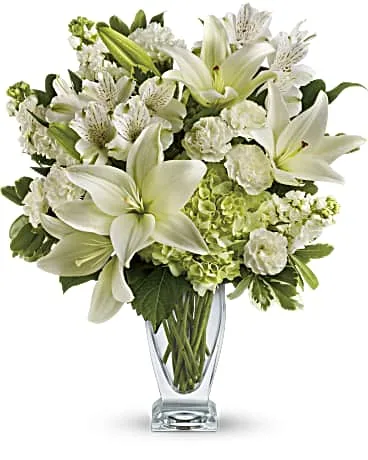
If the family welcomes flowers at home, keep them modest and neutral. A white-and-green vase or basket, such as Bloom Lane’s White & Green or the Serene Bouquet of white lilies, hydrangea, stock, alstroemeria, and carnations, suits a living room better than a standing spray. Ask where the family would like it, and do not place flowers at the photo, lamp, or home shrine unless invited.
Ask about timing, too: whether the family would prefer a delivery during the mourning period or closer to a later remembrance rite.
Donations in lieu of flowers
A family may name a temple or charity instead of, or as well as, flowers. The Delaware resource book notes that a request for donations in lieu of flowers can be included in the obituary. Follow the instruction exactly and give in the person’s full name.
Giving can carry meaning in Hindu mourning, too. HAF’s overview notes that some traditions encourage acts of selfless service during mourning, and Hinduism Today tells of siblings in Kathmandu who decided to fund a scholarship at their village school in their parents’ names.
What to write in a Hindu sympathy card
Keep the message short and sincere. Say you are sorry, share a memory, or offer specific help. Avoid phrases and symbols from another faith.
“Om Shanti” joins om, a sacred syllable, with shanti, the Sanskrit word for peace. The Hindu American Foundation notes that om shanti can serve as a greeting meaning “peace be with you,” and describes the chant om shanti shanti shanti as an invocation of tranquility. It is a prayer phrase, so use it when you know the family would welcome it. If you are not Hindu or are unsure, plain English is just as respectful.
Examples:
- “We are so sorry for your loss and are keeping your family in our thoughts.”
- “With deepest sympathy. We will always remember her warmth and generosity.”
- “Om Shanti. Thinking of you all,” if you know the family would welcome it.
- “A donation has been made to the temple in his memory.”
What to avoid at a Hindu funeral
A few missteps are easy to prevent:
- Do not include a cross or a symbol from another faith in the design or on the card.
- Do not place anything on the body, casket, altar, lamp, or photograph unless the family or priest invites you.
- Do not touch the body or ritual items without an invitation.
- Do not bring a garland or other ritual item the family did not request.
- Do not send a large standing piece to a crematory without the funeral director’s approval.
- Do not bring food before asking about the family’s customs.
- Do not assume one color rule fits every family; when unsure, choose white and green and ask.
Further reading
- Hindu American Foundation: Hindu Funerals: An Overview
- Hindu American Foundation: 5 Things to Know About Hindus and Death
- Hindu American Foundation: Sanskrit Words You Might Be Pronouncing Incorrectly
- Hindu Temple of Delaware: Funeral Services
- Indo American Association of Delaware and Hindu Temple Association: Sahara Indian Funeral Resource Book (PDF)
- Hinduism Today: Thirteen Days of Mourning & Release
- Association of Mandhata Samaj UK: Hindu Death Rites, Suggested Guidelines and Information (PDF)