First, decide who the card is speaking to
A card on funeral flowers for a spouse can face in one of two directions. If you are the surviving husband, wife, or partner, you are usually writing to the person who died, much as you would leave a note on the kitchen table. That card often travels with the casket spray or a standing piece near the casket. If you are a friend or relative, your card speaks to the widow or widower, and it needs to make clear who you are.
Enclosure cards are small, so one to three sentences is plenty. You do not have to sum up a marriage. Some spouses write a single line, and some sign only their name. Either is enough.
Cards on displayed flowers can be read by visitors, and many funeral homes collect them for the family after the service. If some words are meant only for your husband or wife, keep the card simple and write a private letter too. Ask the funeral director whether it can be placed with them.
What to write on a funeral flower card for your wife
These are written to a wife who has died, from her husband or wife. Change any detail that is not yours. A real habit, place, or phrase from your marriage will mean more than a polished line.
- [Name], marrying you was the best thing I ever did. I love you. [Your name]
- Thirty-four years, and I would still choose you on the first day. All my love, [Your name]
- I will keep your garden going as best I can. I love you always, [Your name]
- Thank you for our home, our children, and every ordinary morning. Yours, [Your name]
- You made every room warmer the minute you walked in. I miss you already. [Your name]
- I don’t know how to do this without you, but I will try, for you and for the kids. [Your name]
What to write on funeral flowers for your husband
Most of these work from a wife or a husband; change “wife” where needed. If you had a private name for him, use it. The card is yours, and it can sound like the two of you.
- To my husband and my home. I love you. [Your name]
- You held my hand through everything. I will hold on to all of it. Your wife, [Your name]
- Forty years of you bringing me coffee before I was awake. I will miss that most. [Your name]
- Rest now, my love. You took care of all of us for so long. [Your name]
- Being your wife was the best part of my life. Thank you for every year. [Your name]
- Sleep well, [Name]. I’ll take it from here. Love always, [Your name]
Short funeral flower messages for a spouse
Grief can make writing feel impossible, especially in the first days. A short card is not a lesser card. Add your first name, or the name your spouse called you, and swap in husband or partner where needed.
- Always yours.
- Thank you for loving me.
- Goodnight, my love.
- My heart goes with you.
- I love you. I always will.
- Forever your wife.
How to sign, alone or with the children
A card from the surviving spouse needs only a first name or a familiar sign-off, such as “Your loving wife, Anne” or “Always, Mike.” The florist and funeral home match the flowers to the service through the order details, so the card can be as personal as you like.
When the flowers come from the whole household, agree on the wording first and list names the way the family knows them: “Anne, with Daniel, Sofia, and Luke.” Grown children with their own households may prefer a separate card, so ask before adding anyone’s name.
- Wife, Mom, and the heart of every holiday. We love you and will keep your traditions. [Names]
- Husband, Dad, and the best storyteller we knew. We will keep telling your stories. [Names]
- Thank you for loving all of us so well. From your wife and children, [Names]
- Our family was built on your kindness. We will keep it that way. Love, [Your name] and the kids
For a partner, fiancé, or fiancée
Long-term partners and engaged couples can write exactly as a spouse would. Use the words the two of you used, whether that is partner, love, or simply a first name. Your card does not need to match the title used in the obituary.
If you were not married, the person arranging the funeral may be a parent, an adult child, or another relative. Ask them or the funeral director before ordering a casket spray. A standing spray, wreath, or basket near the casket can carry your card without changing the family’s plan.
- [Name], you were my person. I love you. [Your name]
- We were planning so much. I’m grateful for everything we had. All my love, [Your name]
- Twelve years side by side. You were family to me in every way that counts. [Your name]
What to write to a widow or widower
If you are sending flowers to someone whose husband or wife has died, address the card to them, use their spouse’s name, and sign your full name. In her condolence guide for AARP, etiquette author Lizzie Post says that sharing a personal memory is often one of the loveliest ways to show that the person will be remembered.
Her guide also lists phrases to avoid, including “He’s in a better place now” and “It was God’s will.” Offer only help you will actually give. If you were close to the spouse who died, telling the widow or widower that they are still your family can mean a great deal. If the notice asks for donations instead of flowers, follow it; a card on its own can carry the same words.
- Dear [Name], I am so sorry about [Husband’s name]. The two of you made everyone feel welcome. With love, [Your full name]
- Thinking of you and remembering [Wife’s name]’s laugh from across the room. I’ll call next week. [Your full name]
- Your marriage was one of the best things we ever got to see up close. We are with you today and in the weeks ahead. The Park family
- There are no right words, only love for you and gratitude for [Spouse’s name]. [Your full name]
- [Name], you are family to us, now and always. We love you. [Your full name]
Card or ribbon: short wording for a husband or wife
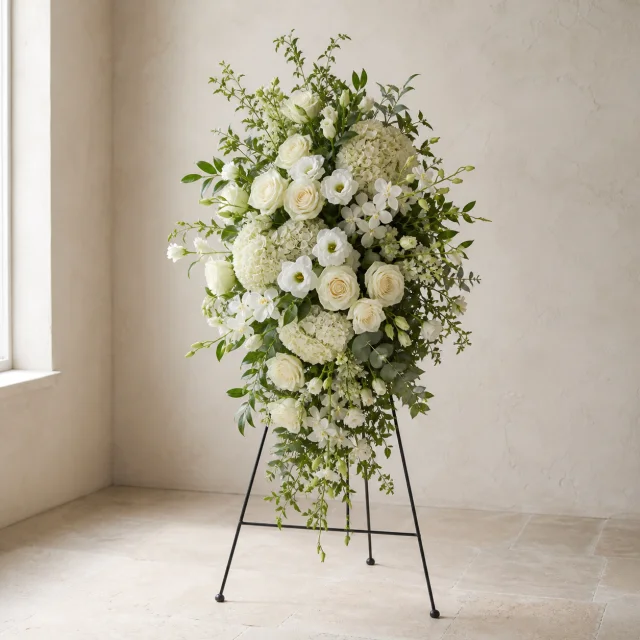
A card and a ribbon do different jobs. The card is a small, personal note that stays with the flowers and usually reaches the family afterward. A ribbon or banner is lettered across a formal piece, typically a casket spray, standing spray, or wreath, where everyone at the service can read it. Keep a ribbon to one to four words and let the card carry the rest.
Lettering is not automatically included with every arrangement. Ask the florist whether a ribbon is available for your design and date, what will fit, and whether it adds to the price. If it is not possible, a clearly signed card still tells the family who the flowers are from.
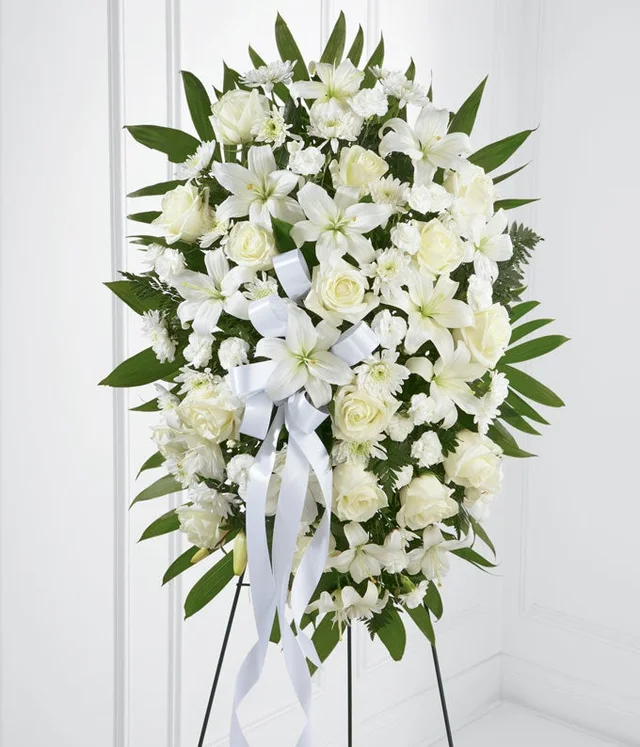
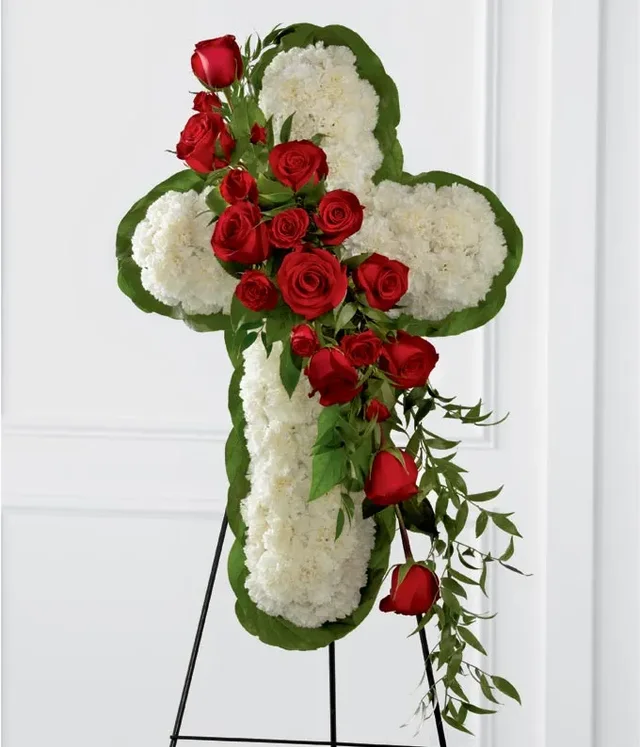
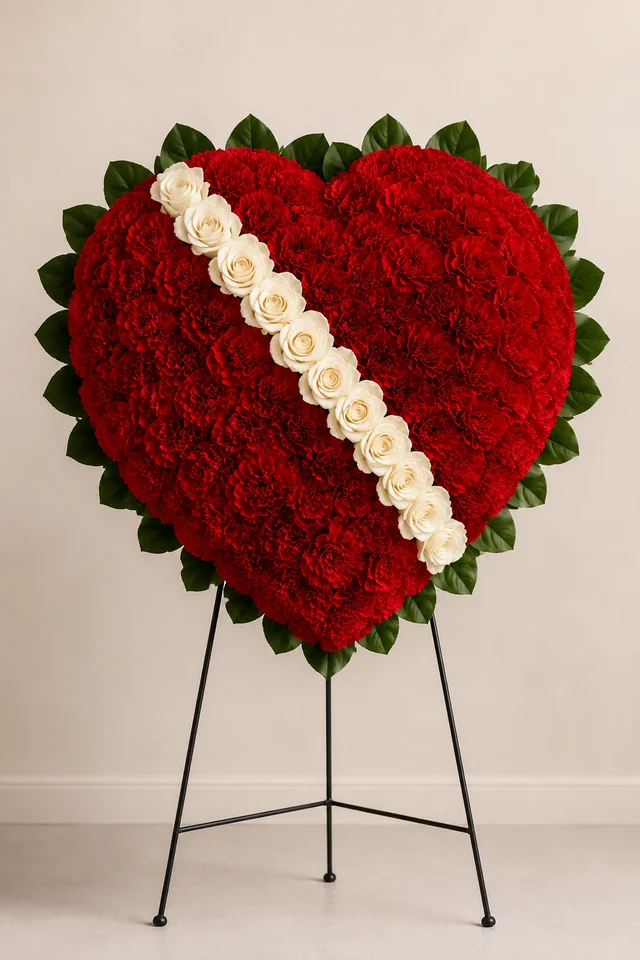
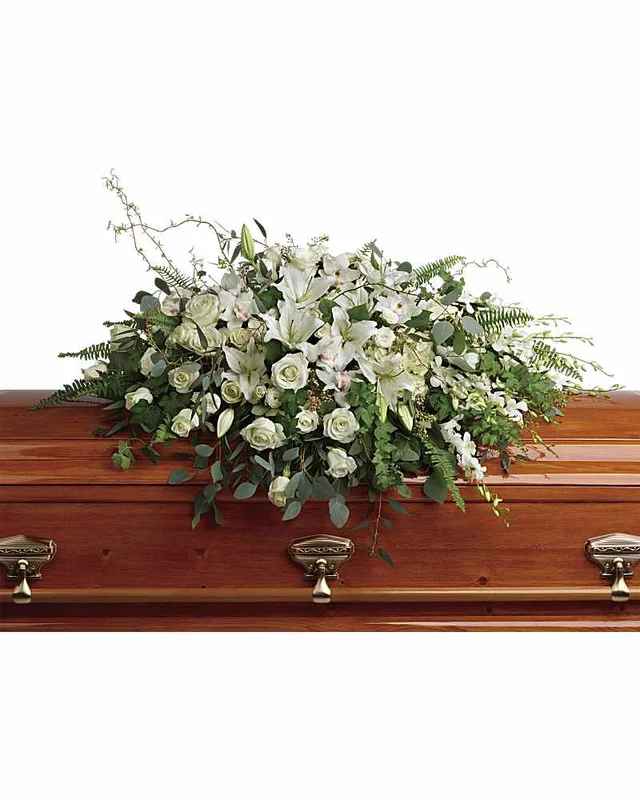
The casket spray is usually ordered by the surviving spouse, often with the children, because it rests at the center of the service. When you order, give the florist your spouse’s full name as it appears on the service notice, the funeral home’s address, and the first viewing or service time. At Bloom Lane, the Casket Spray is made only by our local team for delivery within its service area; it is not available through partner florists or for same-day delivery, so order as early as you can.
- Beloved Husband
- Beloved Wife
- My Love, Always
- Husband, Dad, Grandpa
- Wife, Mother, Friend
- Together 46 Years
- Loving Partner
Faith-based messages, if they fit
A short verse or prayer belongs on the card only when you know it reflects your spouse’s faith, or the faith of the widow or widower you are writing to. A loving message without religious language is always respectful. The first two lines below are from a spouse; the last two are for a card to a widow or widower. Scripture is quoted from the King James Version.
- “Many waters cannot quench love, neither can the floods drown it.” Song of Solomon 8:7. All my love, [Your name]
- Rest in God’s keeping, my love, until I see you again. [Your name]
- “Blessed are they that mourn: for they shall be comforted.” Matthew 5:4. Praying for you, [Your full name]
- “He healeth the broken in heart, and bindeth up their wounds.” Psalm 147:3. Holding you in prayer, [Your full name]
A simple formula for writing your own
If none of these sound like you, build a message in three parts: the name you called your spouse, one true detail, and a line of love or a wish. The detail can be small. Small things are what you shared every day.
For example: “Joe, I’ll miss your off-key singing in the car. Love you forever, Linda.” Read it aloud once. If it sounds like something you would say at home, it is ready.
Leave out the cause of death, money matters, and family disagreements, and check the spelling of every name. Anything you would not want relatives to read belongs in a private letter instead.